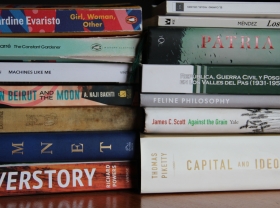
Several years ago, I resolved to write a short response to every book I read. Partly out of respect for the author’s effort, partly to fix it in my memory. Never quite managed it yet, but I came close in 2020. More novels than usual, I think—perhaps a COVID reaction: reaching for literature while life´s on hold—but some other matters, too. So, here goes:
In 1989, as communism was collapsing across Eastern Europe, Francis Fukuyama achieved intellectual celebrity—and notoriety—with a short essay, The End of History? “We may be witnessing,” he wrote, “the end point of mankind's ideological evolution and the universalization of Western liberal democracy as the final form of human government.” A quarter of a century later, he has not quite recanted.
At the outbreak of Algeria’s war for independence in 1952, there were one million French settlers living in that country alone. Today, an estimated 250,000 people of Lebanese descent live in West Africa. Some two million people of Indian descent live in East and Southern Africa (not counting a million or so more on the islands of Mauritius and Réunion.) Numbers like these are worth bearing in mind when approaching Howard French’s book of anecdotal reportage, China’s Second Continent: How a Million Migrants are Building a New Empire in Africa. (Knopf, New York, 2014)
A prizewinning novel explores France’s identity crisis with lyrical panache—and a painful look back at the not-so-glorious past. But hang on a minute. A weird undertow appears to suggest that the answer to present troubles lies in more, er, sexual congress.Vraiment? I thought it was more a matter of politics.
Captain Phillips (Directed by Paul Greengrass, 2013)
The most interesting question about this morality tale of American power efficiently eliminating vermin is whether it should be seen merely as a feel-good pot boiler or whether its uncompromising resistance to depth betrays a wider anxiety about the way the world is going.
Rwandans living or travelling in the West must, I imagine, hate encountering the casual question, “So where are you from?” The answer will surely evoke either polite confusion or else impertinent enquiry. Were you (or your parents) among the killers or the victims, the interlocutor is too likely to wonder, so notorious is the Rwanda genocide brand. And are you a Tutti or a Frutti, or whatever they’re called? If I were Rwandan I would definitely make a habit of claiming to originate from Burundi—a place so few people outside of Africa have heard of that you could be fairly sure of keeping the conversation on an innocuous keel.
Having this year happened to become a temporary resident of Rwanda, I felt the need to situate myself with a bit of reading. And it’s impossible to get away from the genocide as the defining publishing event. So here’s my response to five of the most readily available texts—one ‘novel,’ one memoir, one work of ‘reportage’, one of journalistic analysis, one of scholarship. I review these in the order I read them. Four were written by white North American men, so there was a clear risk that they might say more about North American men, and their way of seeing, than about Rwanda. That’s certainly the case with the first, which disturbed me most but taught me least.
Lost Lion of Empire: The Life of ‘Cape-to-Cairo’ Grogan by Edward Paice HarperCollins, London, 2002. (Paperback, 470 pp)
There is something rather unsettling about a book that relates so much of East Africa’s colonial history with so little mention of the ‘natives,’ who appear in these pages only as nameless and voiceless porters, servants or labourers. This is, to be fair, not a history but a biography: of Ewart Grogan (1874–1967), a British imperial adventurer and entrepreneur whose impact on Kenya was almost as formative as the impact of his hero and early mentor, Cecil Rhodes, on what is now Zimbabwe. (Kenya, however, at least avoided the indignity of ever being called ‘Grogania.’) It is, arguably, also apt that the natives should appear here as anonymous and generally passive, a mere accessory to the story of empire: for that, it seems, is how Grogan saw them. He was, on Paice’s account, a prodigiously energetic, stubborn, and in many ways visionary man. The visions, however, all turned on the economic potential of a ‘virgin’ land. What unsettles 21st century sensibilities is that seeing a place as ‘virgin’ entails—much as in the earlier colonisation of the Americas—seeing its existing human population as largely beside the point.
“El Hombre que Amaba a los Perros” (“The Man Who Loved Dogs”) by Leonardo Padura (2011, Tusquets Editoriales, Barcelona; 765 pp)
There are three main dog lovers in this well-crafted reconstruction of the exile and death of Leon Trotsky: Trotsky himself; Ramon Mercader, the Catalonian communist recruited by Moscow to assassinate him, and Ivan, a young Cuban whose literary ambitions have been reduced to sub-editing on a veterinary magazine when, in 1977, he meets the dying Mercader on a beach outside Havana and eventually becomes the reluctant narrator of the assassin’s tale. The narrative manages to generate suspense despite our knowing in advance the sticky end that awaits Trotsky. Equal skill and scrupulous research are brought to the wider, historical canvas, which features ‘live’ excerpts from the Spanish Civil War and the Moscow show trials as well as snapshots of Kruschev-era Russia and the mass exodus of Cuban citizens from that island in the mid 1990s.
“The Mountain People” by Colin Turnbull (1973, Pan, London; 253 pp)
In Uganda’s far northeast, bordering Southern Sudan and Kenya, the Kidepo National Park offers visitors a rare experience of African wildlife undisturbed by people. Road access is still difficult, but upmarket tourists can charter a light aircraft to fly in to a luxury tented camp where the abundance of game is matched by the abundance of culinary comforts. People who have made the trip say it is unforgettable. Now largely forgotten, however, is the human cost of creating this safari wonderland.
“Blackwater: The Rise of the World’s Most Powerful Mercenary Army” by Jeremy Scahill, (Serpent’s Tail, 2007, 550 pp); “Whoops! Why Everyone Owes Everyone and No One Can Pay” by John Lanchester (Penguin, 2010, 239 pp)
Here is an interesting contrast in efforts at persuasion.
“Blackwater” is a worthy, liberal critique of one of the creepiest facets of our age: the outsourcing of state violence to “security companies” and “defence contractors”—correctly outed in the subtitle as “mercenaries.” This topic deserves serious and widespread attention but, alas, this book has little chance of persuading anyone not already convinced of Blackwater’s intrinsic creepiness. It is unlikely even to add significantly to the armoury of facts and arguments at the disposal of those already so persuaded, because it is such a tiresome read. I could not get past Chapter Two (a disquisition on the family, early life and character of the company’s founder and proprietor, Erik Prince).